Properticopropertico
BackBuy

Buying property in Croatia as a foreigner

Share

Short answer

If you are an EU national, you buy on the same terms as a Croatian citizen. No consent, no reciprocity test. Two exceptions survive: agricultural land and protected natural areas.

If you are not an EU national, you need two things, and they are cumulative: reciprocity between Croatia and your country, and the consent of the minister responsible for justice. Without that consent the purchase contract is not merely unregistrable. It is void (ništetan). That is the single most important sentence on this page, and almost no English-language guide says it.

Everyone buying, foreign or Croatian, needs an OIB before the deed can be registered.

And since 1 January 2025 Croatia levies an annual property tax that every municipality is obliged to charge. If the property is a holiday home rather than your permanent residence, you will pay it.

Can you buy at all?

EU nationals

Zakon o vlasništvu i drugim stvarnim pravima (ZV), art. 358.a(1) takes EU nationals and EU-seated legal persons outside the foreign-acquisition regime entirely:

Odredbe članka 354. do 358. [...] ne odnose se na državljane i pravne osobe iz država članica Europske unije. Te osobe stječu pravo vlasništva nekretnina pod pretpostavkama koje vrijede za stjecanje prava vlasništva za državljane Republike Hrvatske i pravne osobe sa sjedištem u Republici Hrvatskoj.

Article 358.a(2) carves out two categories: agricultural land and protected natural areas.

EEA nationals (Iceland, Liechtenstein, Norway)

Here is a distinction worth knowing, because every English guide glosses over it. The statute names EU member states only. It does not say EEA. Equal treatment for the three EEA states rests on the EEA Agreement operating through art. 354(1), which opens the regime to anything "determined otherwise by law or by international treaty". The ministry and gov.hr both treat EEA nationals as equivalent. The outcome is not in doubt, but the route is different, and you should not rely on anyone who tells you art. 358.a says "EU/EEA". It does not.

Swiss nationals

Treated separately on both official pages. A Swiss natural person gets equal treatment and needs no consent, but must attach a confirmation of registered temporary residence to the land-registry application. Swiss legal persons fall under a further set of rules. (Confidence: medium. Sourced to gov.hr and the ministry; we did not trace the underlying bilateral instrument.)

The Croatian-diaspora exception nobody mentions

ZV art. 355(2) provides that emigrants from Croatia and their descendants, where the citizenship authority has found they meet the conditions for acquiring Croatian citizenship, are not foreign persons for the purposes of this Act. If that describes you, you may not need the consent you are being told to apply for. Worth checking before you start a procedure you may not need.

Non-EU nationals

Both conditions must be met. See the next section.

Buying through a Croatian company

ZV art. 355(3) sets a seat test, not a nationality test:

(3) Pravna osoba smatra se sa stajališta ovoga Zakona stranom osobom kad ima registrirano sjedište izvan područja Republike Hrvatske, osim ako je zakonom drukčije određeno.

A company with its registered seat in Croatia is therefore not a foreign person, and arts. 356–357 do not apply to it, regardless of who owns the company. That is what the statute says, stated as fact. We are not advising you to do it, and two limits are worth stating plainly: we did not search other statutes for anti-avoidance or beneficial-ownership rules, and for agricultural land the position is unclear, because the agricultural land Act contains no definition of a foreign legal person at all.

Non-EU buyers: reciprocity and consent

The contract is void without consent

ZV art. 357(1), the provision that matters most:

(1) Ako je za stjecanje prava vlasništva nekretnine potrebna suglasnost ministra nadležnog za poslove pravosuđa Republike Hrvatske, pravni posao kojemu je cilj stjecanje toga prava vlasništva ništetan je bez suglasnosti ministra nadležnog za poslove pravosuđa.

Void, not pending. A buyer who pays before consent is granted is in a far weaker position than "waiting on paperwork". Sequence your payments accordingly, and take Croatian legal advice on how the contract should be structured.

ZV art. 357(3) adds a second trap: if consent is refused, you cannot re-apply for the same property for five years from the date of the refused application.

Which ministry

The statute never names one. It uses the functional formula "ministar nadležan za poslove pravosuđa", meaning the minister responsible for justice. Today that is the Ministry of Justice, Administration and Digital Transformation.

If a source tells you to apply to the Ministry of Foreign Affairs, that source is at least twenty years out of date. Competence moved in 2006. This error is still circulating in English-language guides that rank on the first page of Google.

Reciprocity is not a yes/no question

The ministry maintains a country-by-country table with three states: reciprocity exists, reciprocity does not exist, and determination in progress. Many entries carry conditions. Three findings that contradict what most English guides say:

  • Canada: reciprocity recorded as not existing from 1 January 2023 to 31 December 2026, for residential property in larger municipalities
  • Australia: recorded as not existing from 1 April 2025 to 31 March 2027, for existing properties
  • United States: handled state by state, not as one country

Those entries were read on 1 November 2026 and two of them are time-limited, with the Canadian entry expiring within months. Do not rely on this paragraph as current. Check the ministry's live table for your own country before you do anything else.

What you submit

From gov.hr: the legal basis for acquisition (the contract) in original or certified copy; proof of the seller's ownership, i.e. a land-register extract; a certificate from the body responsible for town planning on the legal status of the property, stating whether it lies within a designated building zone; and proof of citizenship. A power of attorney is needed where a representative acts, and an applicant abroad without a representative must appoint a recipient for service resident in Croatia. The ministry notes that further documents may be requested.

How long it takes

No official Croatian source publishes a processing time for this procedure. We checked gov.hr, both ministry pages, and the statutory text. Any specific figure you find in an English-language guide is unsourced. One widely ranking page states "two to six months" with no source at all.

Do not confuse the five years in art. 357(3) with a processing time. That is a bar on re-applying after a refusal.

A change that may be coming

An amendment to ZV art. 358.a was passed in NN 52/2025 but has not entered into force. It commences on the day Croatia accedes to the OECD. If and when that happens, it extends equal treatment to EEA states, OECD members and states adhering to the OECD liberalisation codes. That would remove the consent requirement for the UK, US, Japan, Canada, Australia, Korea, Türkiye, Israel, Mexico, Chile, New Zealand and Switzerland. Agricultural land would still be excluded. This is not current law. Check its status if you are a non-EU buyer, because it would change your position materially.

Agricultural land: an unresolved position

This is the part of Croatian property law where we can tell you what the sources say but cannot tell you the answer, and anyone who gives you a confident one-line answer is overstating their case.

As a matter of EU law, the restriction has expired. The transitional period for restricting acquisition of Croatian agricultural land by EU and EEA nationals ran out on 30 June 2023. Commission Decision (EU) 2020/787 extended it to that date, and recital (1) states that it "may only be extended once for a period of up to 3 years". That option was used. There is no further extension available.

As a matter of Croatian domestic law, nothing was amended. ZV art. 358.a(2) still carves out agricultural land. The Agricultural Land Act art. 2(2) still reads as a prohibition on foreign ownership, and was re-enacted as recently as NN 136/2025, in November 2025.

And no Croatian official page states the current position. The government's own English-language page still reads, in the future tense, that EU citizens "cannot acquire agricultural land until 30 June 2023", more than three years after that date passed.

What that means for you: the EU-law basis for the restriction is gone; the domestic provisions have not been repealed; and the state has not published a position. Take Croatian legal advice before contracting to buy agricultural land, and do not act on any blog that tells you this is settled, including this one.

OIB: the number you need before you sign

The OIB is Croatia's personal identification number. You cannot register ownership without one, because the deed itself must state it.

Zakon o zemljišnim knjigama art. 49(2) requires that deeds submitted as the basis for registration state the OIBs of the persons against whom and in whose favour registration is sought. This has been the law since 2019, not, as is sometimes written, since the 2024 amendment.

The requirement is nationality-neutral. It attaches to whoever is being registered. A Croatian buyer needs one too. The only difference is that a Croatian citizen already has one and you do not.

How to get one. A foreign person becomes an OIB holder when a "reason for tracking" arises in Croatia, and acquiring property is expressly one (Zakon o OIB-u art. 5(1)). You apply to the Tax Administration office for the area where the property is located; if that cannot be determined, to the Zagreb regional office. You need the completed application form, available in Croatian, English and German, and your passport. Failing a passport, an EU identity card or a national identity document plus proof of citizenship.

EU and EEA citizens can apply online through the europe.gov.hr system. Everyone else applies in Croatia, in person or through a representative.

You can use a representative. The power of attorney must be in Croatian or translated, and must be issued specifically for the OIB procedure. A power of attorney granted to a notary, lawyer, tax adviser, public body or bank does not require notarisation; one granted to a private individual does.

It is free. The Ordinance on the OIB art. 54 provides that no fee is charged, either for assigning the number or for issuing the certificate.

How long? No processing time is published for the standard procedure. The procedure is designed so the certificate is handed over at the counter.

The purchase process

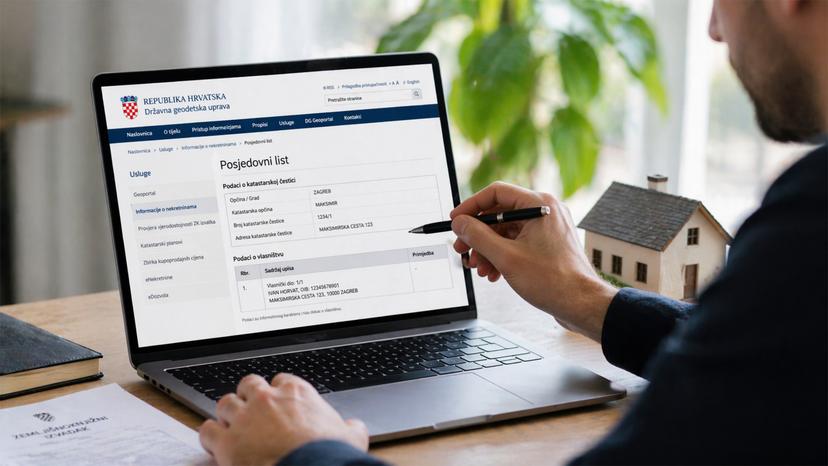
  1. Check the title before you pay anything. A land-register extract shows the owner, any mortgages and any pending entries. Our guide on how to check who owns a property covers how to read one.
  2. Check the building's paperwork. Whether the building has an occupancy permit (uporabna dozvola) is a separate question from who owns it, and it affects financing and resale. See when a property needs an occupancy permit.
  3. Non-EU buyers: deal with consent before money moves. The contract is void without it.
  4. Obtain an OIB.
  5. Pre-contract and deposit. A deposit (kapara) is customary. What happens to it if the deal fails depends on what the contract says.
  6. Notarised purchase contract. The seller's signature is certified by a notary.
  7. Registration in the land register. This is the step at which ownership actually passes. Until you are registered, you are not the owner. The court fees are 10,00 EUR for the application and 30,00 EUR for the decision on registering ownership, five times higher if you file more than 60 days late.
  8. Tax. The transfer tax assessment follows.

Each step is set out in order, with the points where a foreign buyer's sequence differs, in the purchase process step by step.

Costs and taxes

Transfer tax or VAT, never both

Real-estate transfer tax is 3% of market value, paid by the buyer. It applies only where VAT is not charged on the acquisition, broadly resale property and purchases from private individuals. New build from a VAT-registered developer carries 25% VAT, which is already inside the advertised price.

The practical consequence for budgeting: on a resale property the advertised price is only the price, and 3% comes on top. On a new build it does not.

Note that the refund of transfer tax available to buyers under 45 is conditional on Croatian citizenship and registered residence. It is not available to you as a foreign buyer, whatever a translated article may appear to suggest.

The annual property tax, in force since 1 January 2025

This is the item most English guides get wrong, and they get it wrong in both directions. One widely ranking page states Croatia has no annual property tax. Another states owners pay 1.5% of appraised value. Both are wrong.

The Local Taxes Act, as amended by NN 152/2024 with effect from 1 January 2025:

  • Every municipality is obliged to levy it (art. 20(1)). It is not optional and not confined to the coast.
  • The charge is 0,60 to 8,00 EUR per m² of usable area per year (art. 26(1)). There is no valuation and no percentage anywhere in the charging provisions.
  • The rate within that band is set by the municipality or town, and may vary by street, settlement or zone, and be increased for age or features that add value (art. 26(2)–(6)). Where a municipality sets no rate, 0,60 applies by default.
  • Foreign owners are expressly within the charge. Art. 25(1) names "domaće i strane" persons owning property on 31 March of the tax year.

The exemptions are what matter for a holiday home. The two generally available reliefs both depend on permanent dwelling: the property serves as a permanent residence, or it is let under a permanent-residence lease for at least ten months in the tax period (art. 27(1)(1) and (2), art. 27(5)).

Three points follow, and they are the reason this section exists:

  • Registering your residence at the address does not prove permanent dwelling. Art. 27(3) says so expressly, and art. 27(4) allows the tax authority to test the claim against infrastructure-usage data, meaning utility consumption.
  • Letting to tourists gives no relief at all. Art. 25(4) states that paying income tax on holiday-let income, or registering the place as non-commercial accommodation, has no effect on the property's status for this tax.
  • Therefore a holiday home owned by a non-resident, not permanently inhabited and not let for permanent residence, is taxable.

For scale, an 80 m² apartment works out at roughly 48 EUR a year at the floor rate and 640 EUR at the ceiling. Treat that as arithmetic from the statutory band, not a quotation: the actual rate is your municipality's, and "usable area" is defined by a separate regulation we have not examined, so it may not match the floor area in the listing.

Changes affecting liability must be reported by 31 March of the tax year (art. 49.a). Owners who pay komunalna naknada, and those whose permanent-residence lease is already reported for income tax, need not file.

What foreign buyers most often get wrong

  1. Assuming consent only delays registration. It does not. Without it the contract is void (art. 357(1)).
  2. Treating reciprocity as settled. It is country-specific, conditional, time-limited, and state-by-state for the US. Canada and Australia are currently recorded as not having it.
  3. Applying to the Ministry of Foreign Affairs. Twenty years stale.
  4. Believing a quoted processing time. None is published.
  5. Assuming there is no annual property tax. There has been one since January 2025, every municipality must levy it, and a holiday home does not qualify for relief.
  6. Assuming registered residence proves permanent dwelling for tax relief. The Act says it does not.
  7. Reading "until 30 June 2023" on a government page as a live deadline. That date has passed; the position since is unresolved.
  8. Assuming EU and EEA are treated identically by the statute. The text names EU member states only.
  9. Believing the under-45 transfer tax refund is available to foreign buyers. It is gated on Croatian citizenship.

Frequently asked questions

Informative notice

This guide is for general information and is not legal, tax or financial advice. It describes Croatian legislation as we read it on the date stamped at the top. Croatian law changes, the reciprocity table changes country by country, and at least one amendment affecting non-EU buyers is passed but not yet in force. Decisions in individual cases are made by the competent authority. Before committing to a purchase, take advice from a Croatian lawyer and confirm your own position with the relevant authority.

Sources

All read on 1 November 2026, except the court fees, read on 19 November 2026.

  • Zakon o vlasništvu i drugim stvarnim pravima, arts. 354, 355, 356, 357, 358.a. NN 91/96 with subsequent amendments to 52/25.
  • Zakon o zemljišnim knjigama, arts. 49, 237. NN 63/19, 128/22, 155/23, 127/24.
  • Uredba o Tarifi sudskih pristojbi, Tar. 14 and 15. NN 50/2026.
  • Zakon o osobnom identifikacijskom broju, arts. 5, 8. NN 60/08, never amended.
  • Pravilnik o osobnom identifikacijskom broju, arts. 14, 15, 54. NN 1/09 with amendments to 101/25.
  • Opći porezni zakon, art. 17.
  • Zakon o lokalnim porezima, arts. 20, 25, 26, 27, 49, 49.a. NN 115/16 with amendments to 152/24.
  • Zakon o poljoprivrednom zemljištu, art. 2. NN 20/18 with amendments to 136/25.
  • Commission Decision (EU) 2020/787 of 16 June 2020, art. 1 and recital (1).
  • gov.hr, "Kupnja nekretnina za strane državljane".
  • Ministry of Justice, Administration and Digital Transformation: acquisition by foreign persons, and the reciprocity table.
  • Porezna uprava: assignment of the OIB, and the annual real-estate tax.

Know the rules? Now find the property

Browse verified listings across Istria, Kvarner and the Adriatic coast, and save favourites to compare.

Search properties
Propertico

Propertico

Propertico is a fresh platform for buying, selling and renting property, built with one goal: to make finding a home simple, transparent and modern.