
Properticopropertico
BackBuy

Step-by-step apartment buying process: from budget to title registration

Share

Buying an apartment is not a single signature but a series of steps that follow a specific order. When you know the order, it is easier to estimate where you are, what follows, and what you need money for.

This guide goes through seven steps, from budget to key handover, with an overview of who does what and what is paid. For each step that requires more detail, there is a separate guide we refer you to.

Seven steps in one place

StepWho does itWhat is paid
1. Budget and creditYou and the bankBank fees and property appraisal, according to the bank's terms
2. Choosing a propertyYou, if necessary an agencyAgency commission, if agreed upon
3. Ownership and documentation checkYou, if necessary a lawyerUnofficial insight into the land registry is free
4. Pre-contract and depositBuyer and sellerDeposit, the amount is agreed upon by the parties
5. Purchase agreementPublic notaryCertification or solemnization according to the public notary tariff
6. Ownership registrationPublic notary or attorney, municipal court€10.00 and €30.00 in court fees
7. Tax and handoverTax administration, youReal estate transfer tax 3%, if VAT is not paid

1. Determine your budget and check your creditworthiness

Before you start looking at listings, know how much you can afford. The budget is not just the price of the apartment. It includes the down payment, real estate transfer tax or VAT, public notary fees and ownership registration, potential agency commission, and money for moving and furnishing.

If you are buying on credit, the bank looks at two prescribed ratios. The monthly repayment of all your housing loan debts must not exceed 45% of income (DSTI), and the amount of the real estate-secured loan must not exceed 90% of its value (LTV). These are the upper limits from the Decision on consumer lending criteria, not a recommendation. The bank may approve less, and exceptions above the limits may only be applied to a limited portion of its loans.

Calculate an approximate amount in the creditworthiness calculator, and the rules are explained in the guide Creditworthiness: how banks calculate it. We have broken down how much money you need to have on the side in the guide How much to save before buying real estate.

2. Find a property

Decide what is really important to you: location, number of rooms, floor, parking, distance from work and school. Along with the price, assess the condition of the building and the apartment, as renovation can significantly change the total cost.

Check the energy class. The seller must state it in the listing, and must show you the energy certificate before purchase. Compare the required energy per m² between the apartments you are interested in, not just the letters.

If you are buying through an agency, check the amount of the commission and who pays it in the mediation agreement before you go to the viewing.

3. Check ownership, encumbrances, and documentation

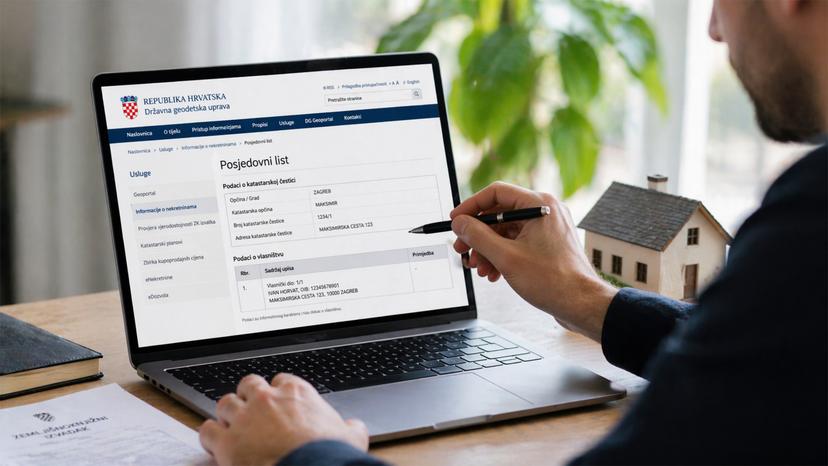
Before making any payment, check the land registry extract. It shows who the owner is and whether there is a mortgage or some other encumbrance. The cadastre provides technical data and is not proof of ownership. Unofficial viewing is free on the Uređena zemlja portal, and an official extract is obtained via the e-Građani system.

In addition to ownership, check the usage permit and, in the case of an apartment, whether the building is floor-divided (condominium). How to do this is described in the guides How to check property ownership and Usage permit: when it is needed and when it is not.

4. Pre-contract and deposit

When you reach an agreement with the seller, a pre-contract is usually concluded. It contains the description of the property, the price, the deadline for concluding the main contract, and the deposit amount.

A deposit (kapara) is money given by the buyer as confirmation of the agreement. Its amount is agreed upon by the parties. What happens to the deposit if someone withdraws is regulated by the Civil Obligations Act (Zakon o obveznim odnosima), and the pre-contract should clearly state this. Do not give a deposit before you have checked the registry extract.

If there is a mortgage on the apartment, request a letter of intent from the seller's bank with the amount of the remaining debt and the payment account. Thus, it can be agreed in the contract that part of the price goes directly to closing the debt, after which the bank issues a release of lien (brisovnica).

5. Sales contract at the public notary

The main contract regulates the price, payment plan, handover deadline, and condition of the property. The seller's signature is verified by a public notary or the contract is solemnized. If you are buying on credit, harmonize the form of the contract with the bank's conditions.

The contract or a special document must contain a tabular statement (tabularna izjava): the explicit consent of the seller for the buyer to be registered as the owner. Without it, registration is not possible. When the price is paid in installments, the tabular statement is often handed over only after the final payment.

The cost of the public notary depends on the type of verification and the value of the contract according to the public notary tariff. Ask for a calculation in advance.

6. Ownership registration in the land register

You become the owner by registration, not by signature. The proposal for registration is submitted electronically, via a public notary or attorney, to the municipal court that maintains the land register.

As of June 1, 2026, a court fee of €10.00 is paid for the submission requesting registration, and another €30.00 for the decision on ownership registration, according to the Regulation on the Court Fee Tariff (NN 50/2026).

You can track the status of the case on the Uređena zemlja portal. How long registration takes depends on the land registry department.

7. Real estate transfer tax and handover

Real estate transfer tax is 3% of the market value and is paid by the buyer within 15 days of the delivery of the decision. If VAT is paid on the purchase, which is often the case with new construction, transfer tax is not paid. Details and tax refunds for those under 45 are described in the guide Real Estate Transfer Tax.

The last step is the handover. Draw up a record with the date, the condition of the apartment, the number of keys, and the readings of the electricity, water, and gas meters. This prevents later misunderstandings regarding bills and damages.

If you are moving in, register your residence at the new address and contact the building manager.

Conclusion

The sequence is what makes a purchase secure: first the budget, then the check, then the deposit, then the contract, and finally the registration. When steps are swapped, most commonly when a deposit is given before checking the extract, the risk increases without any benefit.

If you are just starting, begin with the numbers. The Creditworthiness Calculator provides an approximate amount in a few steps, and the budget planning guide helps put together the rest of the calculation.

Frequently Asked Questions

Start with the numbers

Calculate how much credit you can get, and then search for apartments in that range.

Calculate creditworthiness
Propertico

Propertico

Propertico is a fresh platform for buying, selling, and renting real estate, built with one goal: to make finding a home simple, transparent, and modern.