
Properticopropertico
BackBuy

Creditworthiness: how banks calculate it and how to calculate it yourself

Share

Creditworthiness is a bank's assessment of whether you can regularly repay the loan you are requesting. It is not the same as your salary, it is not the same as the price of the apartment you want, and it is not a matter of negotiation with a banker. As of July 1, 2025, part of this assessment is prescribed and binding for all banks, and from October 1, 2026, a new decision is applied that has further tightened some of these rules.

This is actually good news for the buyer. It means you can calculate the framework within which you can move in advance, even before you open the listings, and that the differences between banks are no longer arbitrary. This guide explains exactly what the bank calculates, which figures enter the calculation, and how you can perform the same calculation yourself.

Calculate your creditworthiness

Free calculator according to HNB rules: in four steps and about 40 seconds, you get an approximate loan amount, monthly installment, and the maximum property price you can finance.

Open calculator

What is creditworthiness

Creditworthiness is the answer to the question of how much you are allowed to borrow so that it is likely you will repay the loan regularly. The bank must assess it before concluding every contract.

It is important to distinguish between two levels. The first is the regulatory minimum prescribed by the Croatian National Bank, which no bank may fall below. The second is the bank's internal policy, which is often stricter. The HNB explicitly states that the prescribed criteria do not replace the banks' internal procedures and that banks continue to independently determine their own credit policies, but these policies must be aligned with the prescribed minimum.

That is why two banks can offer different amounts for the same income. Both respect the same legal framework, but within it, they assess risk in their own way.

Two ratios that decide: DSTI and LTV

Odluka o kriterijima kreditiranja potrošača (NN 107/2026), which has been applied since October 1, 2026, retained two ratios that are the backbone of every assessment. It replaced the first such decision from 2025 and lowered the quotas for exceptions, while the limits themselves remained the same.

DSTI: how much of the income goes to installments

DSTI is the ratio of the monthly total debt repayment cost to monthly income. The formula is simple:

DSTI = total monthly obligations ÷ monthly income

For a housing loan, DSTI must not exceed 45%. For non-housing loans, such as cash or car loans, the limit is 40%.

Crucially, the ratio is calculated on the total debt, not just the new installment. If you are already paying €200 per month for another loan, those €200 reduce the room for the housing installment.

If you do not want to calculate manually, the creditworthiness calculator calculates the same ratio with your figures, immediately subtracting overdrafts and cards from existing obligations.

LTV: how much loan per property value

LTV is the ratio of the approved loan amount to the value of the property serving as security. It must not exceed 90%, for every consumer loan secured by real estate, not just housing loans.

Here is a detail that buyers most often overlook. The value of the property is not automatically the price from the contract. The decision stipulates that it is the value from the assessment of an authorized appraiser or that defined by the purchase agreement, and if both are available, the lower one is taken.

The numerator of the ratio also includes all unpaid claims already secured on the same property, except those that are closed with the funds of the new loan.

RestrictionHousing loanNon-housing loan
DSTImaximum 45%maximum 40%
LTVmaximum 90%maximum 90% if secured by real estate
Maturitymaximum 30 yearsmaximum 10 years, or 30 if secured by real estate

Restrictions apply to loans contracted from July 1, 2025, and a new decision applies from October 1, 2026. For the application of the limits themselves, the date of contract conclusion is crucial, not the disbursement date.

How the bank calculates your income

This is the part that surprises buyers the most, as "income" in the calculation does not always match what you perceive as your earnings.

The bank sums the receipts of you and any co-borrowers from non-independent work, independent activities, capital, assets and property rights, and other income, but only those that are regularly earned, net of taxes and contributions and reduced to a monthly level.

  • From capital income, only paid interest, dividends, and profit shares based on equity participation are included.
  • One-off and occasional allowances are not included, such as jubilee and special rewards. The exception is the income tax refund, which is included.
  • An average is taken of at least the last three months preceding the creditworthiness assessment. This is the lower limit; the bank may take a longer period.

Practical consequence: a bonus paid once a year will usually not increase your creditworthiness as much as you expect. Stable and repeatable income is worth more than high but unpredictable income.

What is included in the total debt

The total debt includes all outstanding obligations of you and any co-borrowers to banks and other creditors before concluding the contract, including the new loan you are seeking and obligations for which you are a co-borrower for someone else.

Two items are not included: a loan or obligation that is being closed with the funds of the new loan, and one-off obligations on a charge card.

Overdrafts and cards have their own calculation rules, and they are not the same:

ObligationHow the monthly cost is calculated
Current account overdraft
(authorized and implicit)
3% of the average daily utilized overdraft amount in the three months before the assessment
Credit card loan3% of the utilized amount at the end of the month preceding the assessment
Loan with unknown installment or termassumed annuity repayment with a remaining term of 36 months

The difference between these first two items is significant in practice. For overdrafts, the average over three months is considered, so reducing it a month before the application will not completely erase it from the calculation. For cards, the balance at the end of one month is considered, so closing the card neatly before the assessment has a direct effect.

Example: if you used an average of €500 of your overdraft in the last three months, the bank will include €15 per month in the total debt. The amount seems small, but for a buyer near the limit, even €15 can decide whether the loan will be approved.

The overdraft and the card themselves are not subject to the DSTI restriction. They enter the calculation as a debt cost for other loans.

Calculation example

HNB provides an illustrative example in its explanations that well demonstrates how the two ratios work together.

A married couple has a total monthly income of €2,500 and is seeking a loan for 25 years with an interest rate of 4%. The property value is €240,000.

ConditionCalculationResult
DSTI 45%45% of €2,500highest annuity €1,125
Maximum loan for 25 yrs.annuity €1,125, 4%approx. €213,135
Maximum loan for 30 yrs.same annuity, longer termapprox. €235,644
LTV 90%90% of €240,000216.000 €

For a 25-year term, the limit is DSTI and the loan cannot exceed approximately €213,135. If the term is extended to 30 years, the DSTI would allow for €235,644, but then the LTV becomes the limiting factor, so the loan cannot exceed €216,000.

A lesson for the buyer: extending the term does not open up unlimited space. At some point, you are stopped by the value of the property, not your income.

You can repeat the same example with your own income, term, and interest rate in the creditworthiness calculator, which displays both the loan amount and which of the two limits is decisive in your case.

Exceptions: when a bank is allowed to cross the limit

Limits are not absolute. Banks are allowed to approve a portion of loans even above the prescribed ratios, but within quotas monitored quarterly. A new decision has halved these quotas, so from October 1, 2026, the room for exceptions is half of what it was before.

  • Housing loans above a DSTI of 45%: maximum of 10% of the total amount of housing loans paid out in the previous quarter.
  • Non-housing loans above a DSTI of 40%: maximum of 5%.
  • Loans above an LTV of 90%: maximum of 10%.

Before October 1, 2026, these quotas were 20%, 10%, and 20%. If you encounter those figures somewhere, they refer to the previous decision.

Additionally, at least 75% of these exceptions must go to consumers who are resolving their housing issue through the purchase, construction, or renovation of a property.

For the buyer, this means two things. An exception exists and is worth asking about if you are near the limit, especially if you are buying your first home. But the quota is small and there is no right to an exception. The bank approves it according to its own assessment and is obliged to document every deviation. Since the quota has been halved, expect banks to allocate them more selectively than before.

Credit history: what the bank sees and how to check it

In addition to figures, the bank looks at how you have handled your obligations so far. Data is exchanged through the OSR system managed by Hrok, and almost all banks in Croatia, leasing companies, and card companies participate in the exchange.

You have the right to know whether your data is processed in this system, what data it is, and which institution provided it. You submit a request for access to personal data directly to the credit or financial institution of which you are a client. The request can also be sent to Hrok by mail, but then with a signature certified by a notary public.

This is a step worth taking a few months before purchase. Buyers often think everything is settled, while the system still shows a card limit, an old obligation, or a co-debtorship they had forgotten about.

It's not just about you: the property must also pass

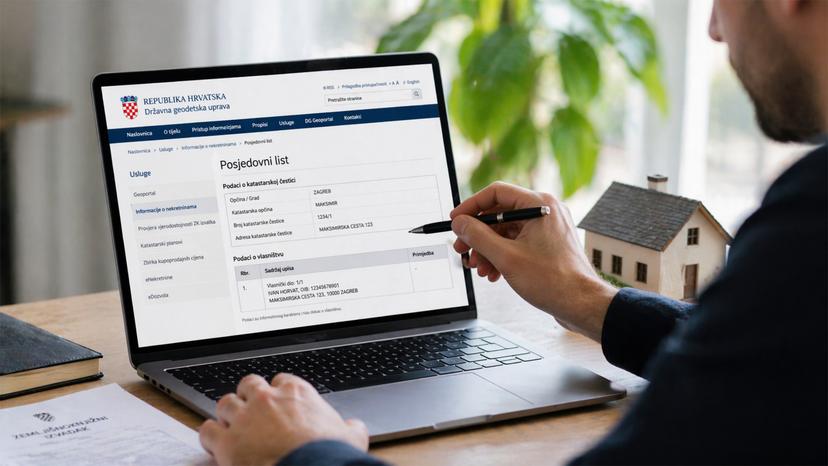
A housing loan is usually secured by a mortgage, so the bank also assesses the property. Proper ownership, clear encumbrances, a usage permit, subdivision (condominium conversion), and a realistic value assessment are just as much a part of the approval as your income.

You can be completely creditworthy and still have the financing fall through due to property documentation or the appraisal being lower than the agreed price. We go through how this is checked in advance in the guide Step-by-step apartment buying process.

How to increase creditworthiness

The bulk of the work is done before you even submit the application.

  1. Close small loans. Every installment that disappears frees up the same amount of space for a housing installment.
  2. Reduce your overdraft, and do it in time. Since the average over three months is looked at, you should start at least a quarter earlier.
  3. Pay off the used amount on your card before the end of the month preceding the assessment.
  4. Do not take out a new loan before the housing loan. A car on lease a few months before buying an apartment can reduce the loan by tens of thousands of euros.
  5. Consider a co-debtor. A co-debtor increases the income in the calculation, but their obligations are also counted, and they take on a real obligation towards the loan.
  6. Increase your down payment. A smaller loan means both a lower LTV and a lower DSTI.
  7. Compare multiple banks. The regulatory minimum is the same for everyone, but internal policies are not.

You can check the effect of each of these moves in advance: change one item in the calculator and immediately see how much the loan amount moves.

We have broken down how much of your own funds you realistically need to prepare in the guide How much to save before buying a property, and the complete monthly budget framework in the guide How to plan a budget for your first property.

Maximum creditworthiness is not a safe limit

A DSTI of 45% is the upper debt limit, not a recommendation. For most households, a healthier range is 30% to 35% of net income, depending on the number of members, income stability, and existing obligations.

The data confirms this. According to HNB, in 2024, about a third of housing loans were approved with a DSTI greater than 45%, the average DSTI rose from 38% in 2022 to 41% in 2024, and about 30% of housing loans were approved with an LTV greater than 90%. This trend was precisely the reason for introducing restrictions and their subsequent tightening.

A good test before deciding: can you, starting today and for three to six consecutive months, set aside the amount of the future installment without going into the red? If you can, the installment is likely sustainable. If you cannot do it now, it is unlikely to be easier after moving in.

Conclusion

Creditworthiness is no longer a black box. Two ratios, DSTI and LTV, are prescribed and public, income and debt rules are detailed, and exception quotas are known.

This means you can make a rough calculation yourself, before talking to the bank and before getting emotionally attached to a specific apartment. Start with a safe installment, convert it into a loan amount, check if the LTV covers the price you are looking at, and only then open the listings. This entire sequence is also covered by our creditworthiness calculator.

The final assessment is still performed by the bank, based on your documentation, the property appraisal, and their own risk rules.

Frequently Asked Questions

Sources: Decision on Consumer Lending Criteria, NN 107/2026 (in force from October 1, 2026); Decision on Consumer Lending Criteria, NN 50/2025 (previous, no longer in force); HNB: Consumer Lending Criteria; Hrok: OSR system. Data verified on October 6, 2026.

Note: The HNB Q&A document is dated March 19, 2025, and still lists quotas from the previous decision. The 2026 Decision is authoritative.

You know your framework, now find a property

Search listings in a realistic price range and save favorites for comparison.

Search properties
Propertico

Propertico

Propertico is a fresh platform for buying, selling, and renting real estate, built with one goal: to make finding a home simple, transparent, and modern.