
Properticopropertico
BackBuy

How much to save before buying real estate

Share

Planning to buy your first property starts with saving. To enter ownership without stress, it is necessary to collect enough of your own funds, not only for the deposit and down payment but also for all accompanying costs and a reserve for unexpected situations. This guide explains how much you need to save and how to estimate it.

1. Personal equity: down payment and deposit

Kapara (down payment upon pre-contract)

Kapara is paid when concluding a pre-contract to reserve the property until the appraisal and loan approval are completed. The amount is agreed upon by the buyer and seller, and in practice, it is usually around 10 % of the agreed price. It can also be 5% or 15%, depending on the agreement. The down payment is credited towards the purchase price or returned in the event of certain contract terminations, so it is important to have it ready in your account so you can react quickly.

Deposit (own funds for the loan)

A loan secured by real estate must not exceed 90 % of the value of the property, and many banks finance even less, so the buyer must have at least 10–20 % of the property value as a deposit. For an apartment worth €150,000, this means savings of at least €15,000–30,000. Banks sometimes value the property lower than the agreed price, in which case the loan is calculated according to the lower value, so the buyer must have additional funds for the difference. For example, if the bank estimates the value of the apartment at €140,000 instead of €150,000, the buyer must provide an additional €10,000 from their own funds.

Tip: the down payment is often counted as part of the deposit. If you agree on a down payment of 10%, you pay the rest of the deposit (e.g., another 10%) upon the final contract. Therefore, total savings for personal equity often amount to about 20% of the property value. We explained the bank rules in the Creditworthiness guide.

2. Additional purchase costs

In addition to the purchase price, the buyer must plan for a series of additional costs. These can increase the total investment by about 3–6 % of the property value. Below are the most common costs that should be included in savings in advance:

  • Real estate transfer tax: when buying real estate on which VAT is not paid, a tax of 3% is paid within 15 days of delivery of the decision. Those under 45 years of age buying their first property can request a refund of the paid tax or 50% of VAT, but you must pay the tax in advance. We have described the details in the Real estate transfer tax guide.

  • Notary public: the pre-contract and purchase agreement are certified or solemnized by a notary public. The cost depends on the type of certification and the value of the contract according to the notary tariff, so request a calculation in advance.

  • Property appraisal: banks require a property valuation carried out by an authorized appraiser. Check the price with the bank or the appraiser.

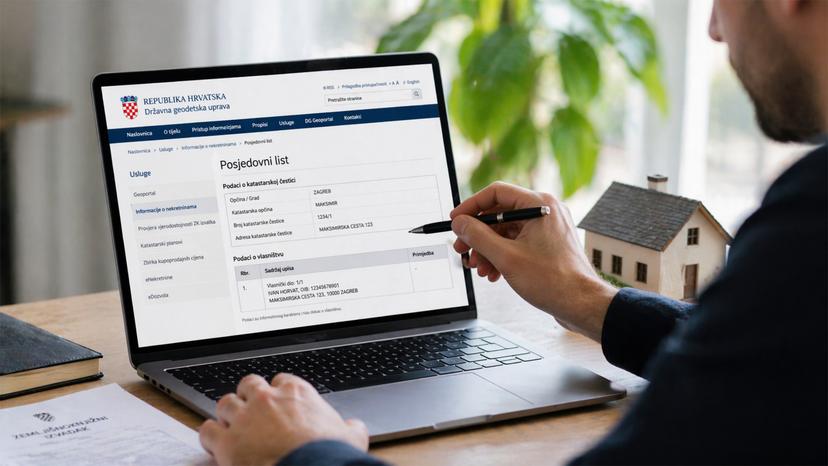
  • Entry in the land registry: the court fee for the application is 10.00 €, and for the decision on the registration of ownership 30.00 € (Regulation on the Tariff of Court Fees, NN 50/2026). If you submit the proposal after 60 days, both are paid fivefold.

  • Agency commission: if you are buying through an agency, check the amount of the commission and who pays it in the mediation agreement.

  • Lawyer and legal check: hiring a lawyer to check the land registry status and prepare the contract is an additional cost to be agreed upon with the lawyer.

  • Insurance and bank costs: for a housing loan, the bank usually requires property insurance and often a loan insurance policy. Check the amounts in the bank's offer.

Total additional costs vary, but count on at least 3–6 % of the property value, depending on whether you buy through an agency and use legal help. If you buy a new building within the VAT system, real estate transfer tax is not paid, but VAT is already included in the price.

3. Reserve fund and unexpected expenses

Buying a property also entails costs that arise after moving in:

  • Renovation and furniture: older properties often require remediation, replacement of joinery, or investment in installations. Plan an additional budget for interior decoration, equipping the kitchen and bathroom, and moving.

  • Maintenance reserve, utilities, and maintenance: apartment owners pay a maintenance reserve for building upkeep, insurance, and shared costs. In addition, utility bills, insurance, and eventual repairs can be higher than when renting.

  • Safety fund: it is good to have saved six months of living expenses as a reserve. This fund protects you in case of job loss, unforeseen repairs, or temporary difficulties in repaying the loan.

4. How much to save in total?

The exact amount depends on the property value, but the following table shows approximate amounts for a property of €150,000 and €200,000 (old construction without VAT):

Property valueDeposit (10–20 %)Of which down payment (5–10 %)Additional costs (3–6 %)Total own funds
150 000 €15 000–30 000 €7 500–15 000 €4 500–9 000 €19,500–39,000 € + reserve fund
200 000 €20 000–40 000 €10 000–20 000 €6 000–12 000 €26,000–52,000 € + reserve fund

The down payment is part of the deposit, so it is not added twice in the total column. These amounts do not include renovation, furniture, and the safety fund, so actual needs may be higher. If you are under 45 and buying your first property, you may subsequently get a part of the tax back, which reduces the actual cost, but does not change the need to pay it upfront.

Conclusion

Saving before buying a property should include more than just the deposit. Funds should be prepared for the down payment, tax, notary, property appraisal, land registry entry, and potential agency commission. Additionally, plan for renovation and an emergency fund. It is realistic to expect that own funds before purchase will amount to 15–25% of the property value plus a safety fund. Calculate the approximate loan amount in the credit health calculator, and the entire purchase sequence is described in the guide Step-by-step apartment purchase process.

Propertico

Propertico

Propertico is a fresh platform for buying, selling, and renting real estate, built with one goal: to make finding a home simple, transparent, and modern.