Real estate transfer tax is the single largest cost that comes on top of the price of an apartment, and simultaneously the one that buyers most often discover too late—when the Tax Administration's decision has already arrived in the mailbox, and the money has been spent on the down payment and furnishing.
The good news is that the rules are clear and the amount can be calculated in advance, down to the euro. This guide explains how much the tax is, who pays it, when VAT is paid instead, who is exempt, and how those under 45 can get part or all of the amount back.
How much it is and who pays it
The rate is 3 %. The taxpayer is the acquirer of the property; in a sale, this is the buyer, not the seller.
The tax base is not necessarily the price in the contract. The base is the market value of the property at the moment the tax liability arises. In most cases, this is the agreed price, but if the transaction is not reported according to market value, the Tax Administration is authorized to determine the value itself through appraisal.
This is important for buyers considering writing a lower price than the actual one in the contract. Apart from being a tax offense, the goal is not achieved either, because in that case, the tax is determined according to the appraised value.
Market value
Tax 3 %
120.000 €
3.600 €
150.000 €
4.500 €
200.000 €
6.000 €
250.000 €
7.500 €
300.000 €
9.000 €
Transfer tax or VAT, never both
This is the most common confusion and source of a difference of several thousand euros in the budget. Both taxes are not paid on the same acquisition. Real estate transfer tax is paid only when VAT is not paid on the acquisition.
Exempt from VAT, among other things, is the delivery of land (except building land) and the delivery of buildings or parts thereof and the land on which they are located if more than two years have passed from the first occupancy or use to the next delivery. In these cases, real estate transfer tax comes into play.
Situation
What is paid
New construction from a developer in the VAT system, within two years of first occupancy
VAT which is included in the price
Building land from a VAT payer
VAT
Resale property or a property where more than two years have passed since the first occupancy
Transfer tax 3 %
Purchase from a private individual who is not in the VAT system
Transfer tax 3 %
Land that is not building land
Transfer tax 3 %
Practical consequence: for new construction, the tax is already in the advertised price and there is no additional cost of 3%. For an older apartment, the advertised price is just the price, and the tax comes on top of it. On a €200,000 apartment, this difference amounts to €6,000.
Who reports the tax and when it should be paid
For transactions occurring after January 1, 2017, reports are submitted by notaries public, courts, or public bodies within their jurisdiction. As a rule, the buyer does not have to report anything personally.
An exception exists and is worth knowing: if someone draws up a document that has not been notarized, they are obliged to report such a transaction themselves to the competent branch of the Tax Administration according to the location of the property, within 30 days of drawing up the document.
After the report, a tax decision arrives. The tax is payable within 15 days from the date of delivery of the decision, and an appeal does not postpone execution, therefore neither of the temporary nor the tax decision.
Who does not pay real estate transfer tax
The law provides for a series of exemptions. For citizens, the most common are these:
persons acquiring real estate in the process of returning confiscated property and land consolidation;
displaced persons and refugees who acquire real estate by exchanging their real estate abroad;
protected tenants who buy the apartment or building in which they reside based on a lease agreement;
citizens who buy an apartment or building on which they had a tenancy right, according to the regulations on the sale of apartments with existing tenancy rights;
persons acquiring real estate according to regulations on the conversion of social ownership;
spouses and common-law partners, life partners, descendants and ancestors, and adoptees and adopters who acquire real estate based on a life or death support contract;
persons who, through dissolution of co-ownership or division of joint property, acquire specific parts of the real estate, regardless of the ratios before and after the division.
Which documentation needs to be attached depends on the basis of the exemption.
Inheritance and gifts
If you inherited the property or received it as a gift, you are exempt if you are:
a spouse or common-law partner, formal or informal life partner, descendant or ancestor in a direct line, adoptee or adopter in relation to the deceased or the donor;
a person to whom the Republic of Croatia or a local and regional self-government unit gifts real estate without compensation for the purpose of compensation or for other reasons related to the Homeland War;
a former spouse or common-law partner, or former life partner, when settling property relations.
Brothers, sisters, nephews, and other relatives outside the direct line are not on that list.
Tax refund for first-time homebuyers up to 45 years of age
This is the most valuable part of the story, and the one that buyers most often fail to use. Individuals and families younger than 45 who do not have and have not had their own real estate can realize a refund of paid real estate transfer tax or 50% VAT when purchasing their first residential property.
There are two separate paths and their conditions are not the same: buying an apartment or house, and building a family house. Check the conditions for your case first.
Conditions for buying an apartment or house:
citizenship of the Republic of Croatia;
purchase agreement concluded after January 1, 2025;
less than 45 years of age at the time of submitting the request;
registered residence at the address of that property and actual residence in it, together with the members of the immediate family listed in the request;
confirmation of paid tax or an invoice with indicated VAT issued after January 1, 2025;
the tax must be paid in full before submitting the request.
Conditions for building a family house are different. There is no purchase agreement or confirmation of paid transfer tax, but instead, the following is required:
citizenship of the Republic of Croatia;
less than 45 years of age at the time of submitting the request;
registered residence at the address of the house and actual residence in it, together with the members of the immediate family from the request;
a usage permit for the house that became final after January 1, 2025;
a construction contract and an issued invoice certified by a supervisory engineer, based on which VAT was paid, as well as paid invoices for design and supervision with clearly indicated VAT.
The right does not belong to the applicant or a member of the immediate family who in Croatia or abroad has or has had an appropriate property for habitation. An appropriate property is considered to be one with water, sewage, and electricity, measuring about 35 m² of usable area for one person with an additional 10 m² for each subsequent member. Anyone who has a property that is not considered appropriate must sell it within 24 months of purchasing the first appropriate one.
The right is also lost if the applicant has previously received state support for acquiring real estate.
Surface area limitation
The law prescribes the maximum useful area according to the number of family members. A surface area up to 50% larger than prescribed is tolerated.
Number of members
Apartment
Family house
1 person
up to 50 m² (tolerance 75)
up to 75 m² (tolerance 112.5)
2 people
up to 65 m² (tolerance 97.5)
up to 97.5 m² (tolerance 146.25)
3 people
up to 80 m² (tolerance 120)
up to 120 m² (tolerance 180)
4 people
up to 90 m² (tolerance 135)
up to 135 m² (tolerance 202.5)
5 people
up to 100 m² (tolerance 150)
up to 150 m² (tolerance 225)
6 people
up to 110 m² (tolerance 165)
up to 165 m² (tolerance 247.5)
7 or more
up to 120 m² (tolerance 180)
up to 180 m² (tolerance 270)
The square footage entered in the land registry as one floor unit is used for calculation. Indoor rooms have a coefficient of 1.00, while lower coefficients are applied for loggias, terraces, and balconies.
Price limitation
Along with the surface area, the price is also limited. A refund is possible if the price per square meter is not more than 50% above the local average price for that local self-government unit. Average prices are published by the Ministry, and an informative calculator is also available.
The calculator is divided into two versions: one for contracts concluded until January 1, 2026, and another for those concluded after that date. Please ensure you use the one that corresponds to the date of your contract, as different sets of average prices apply.
The application is submitted to the Agenciji za pravni promet i posredovanje nekretninama on the prescribed form. The deadline is 24 months from the conclusion of the sales contract.
How much refund you can receive
This is the part that buyers most often assume incorrectly. Meeting the conditions does not automatically mean you get back the entire tax paid. The basis for calculating the highest amount of support is the product of the area you are entitled to based on the number of family members and the average price per square meter in that local self-government unit.
In addition, the rule applies that the calculation is made according to the lower of two prices. If the agreed price is higher than the average, it is calculated according to the average. If it is lower, it is calculated according to the agreed price.
Practical consequence: a buyer who pays a price above the local average or buys an apartment larger than the prescribed area will receive back less than what they paid. A buyer who is below the average and within the area limit can receive the full amount.
Therefore, do not estimate the figure yourself. Enter your data into the ministry's informative calculator, which uses official average prices.
It is not the same as the annual property tax
The two taxes are regularly confused because their names are almost identical. Transfer tax is paid once, upon acquisition. Real estate tax is paid every year while you are the owner.
Real estate transfer tax
Real estate tax
When
once, upon acquisition
every year
How much
3% of market value
from €0.60 to €8.00 per m² of useful area
Who determines
state, uniform rate
municipality or city by its decision
Who pays
the acquirer, i.e., the buyer
the property owner
Main exemption
see the list above
the property is used for permanent residence or is rented for permanent residence
If you live in the property permanently or rent it out for permanent residence, you do not pay the annual tax. Exemption also exists if you cannot use the property due to a declared natural disaster, or if it is evident from the circumstances that residential use is prevented.
Property data, especially changes in calculated area or purpose, and evidence affecting exemptions, should be submitted to the competent Tax Administration office, or the competent local self-government body if it calculates and collects the tax itself, by March 31st of the year for which the tax is determined.
Is the real estate transfer tax abolished?
No. On the date of publication of this article, real estate transfer tax is in force and amounts to 3% of the market value.
Confusion most often comes from three directions. The first is the tax refund for young people, which for some buyers truly means that the amount will be returned to them, but only after they pay it and submit a request, and in an amount that depends on the formula. The second is the introduction of the annual real estate tax, because of which the public talked about a "new real estate tax". The third is occasional announcements of tax regulation changes, which are not the same as the changes coming into force.
Tax regulations change, so before signing a contract, check the current status with a notary public or the Tax Administration.
How to include tax in the purchase budget
Tax is not the only cost on top of the price, but it is the largest. Along with it come notary costs, property valuation, court fees for ownership registration, possible agency commission, moving, and furnishing.
Practical rule: for older properties, count on 3% for tax and another approximately 2% for other purchase costs, so roughly 5% of the price on top of the price itself. On a €200,000 apartment, that's about €10,000 that you must have separate from the down payment.
Real estate transfer tax is a predictable cost: 3% of the market value, paid by the buyer, and only when VAT is not paid on the acquisition. The application is made by a notary public, and the payment deadline is 15 days from the delivery of the decision.
Two things are worth doing in advance. Check whether real estate transfer tax or VAT is payable on your property, as this determines whether 3% will be an additional cost or is already included in the price. And if you are under 45 and buying your first property, check the conditions for a refund before signing, as the 24-month deadline runs from the conclusion of the contract.
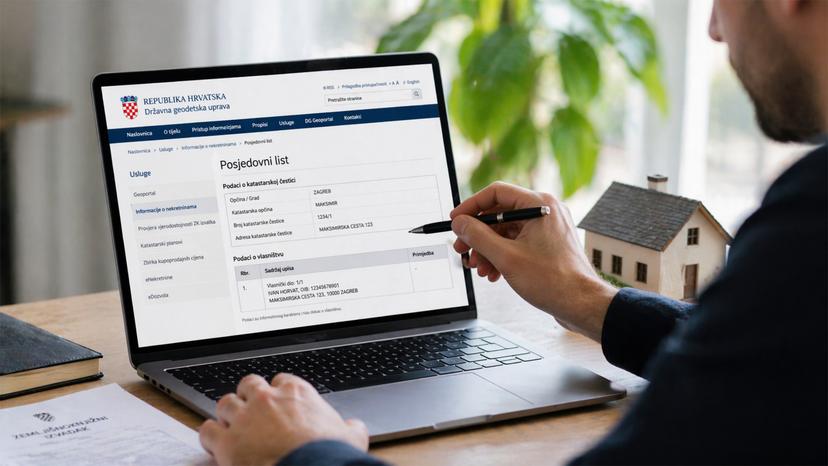
Before signing, it is also worth checking the legal status of the property, which we explained in the guide How to check property ownership.
Propertico is a fresh platform for buying, selling, and renting real estate, built with one goal: to make finding a home simple, transparent, and modern.



 Propertico